


A few of our stories and columns are now in front of the paywall. We at The Chief remain committed to independent reporting on labor and civil service. It's been our mission since 1897. You can have a hand in ensuring that our reporting remains relevant in the decades to come. Consider supporting The Chief, which you can do for as little as $3.20 a month.
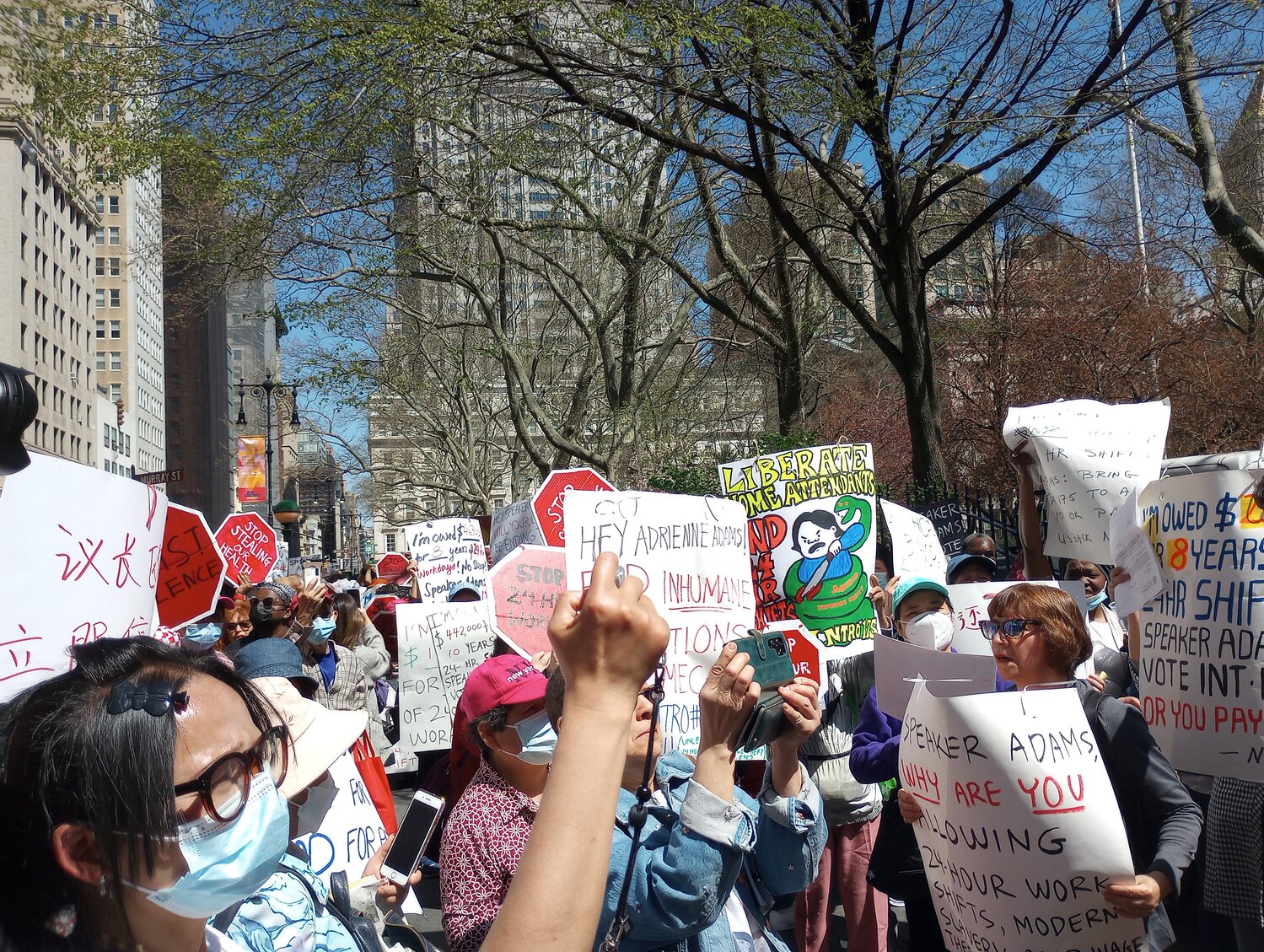
A year after City Council legislation was introduced that would prohibit 24-hour shifts for home health aides, workers and advocates are frustrated the bill has not been adopted into law.
The “No More 24” bill, introduced by Council Member Christopher Marte, would require home health care staffing agencies to split 24-hour shifts into two 12-hour stretches, bar consecutive shifts and set a maximum number of hours home health aides can work each week.
About 200 home health attendants gathered along Broadway near City Hall Wednesday demanding that Council Speaker Adrienne Adams bring the bill to a vote.
Workers at the rally, which was organized by the Ain’t I A Woman?! campaign, spoke of the negative effects years of caring for patients over 24-hour shifts has had on their own health.
Marcola Guzman said she’s developed high blood pressure and back problems after working daylong shifts for a decade.
“If Adrienne Adams does not bring this bill to a vote, I will never get back my sweat, my lost years, my pain and suffering,” she said through a translator.
Nu Jun Zhu, who said she has worked three consecutive 24-hour shifts for eight years, said her right arm was injured, her eyesight diminished and she has back pain due to the grueling work and loss of sleep.
“My patients need to be lifted from a wheelchair to the toilet 20 times a day, so we were excited that Council Member Marte pushed Intro 175, to protect the health and the safety of us and the patients, yet Speaker Adams keeps delaying putting it to a vote to end the 24-hour workday,” she said through a translator.
Both workers noted that they were owed hundreds of thousands in wages: state law allows home-care staffing agencies to pay 13 hours for 24-hour shifts, as long as workers get eight hours of sleep and five hours of “uninterrupted sleep.”
Last year, an arbitrator ruled that 42 home-care staffing agencies must pay $30 million in unpaid wages to 120,000 current and former home health aides after 1199SEIU filed a grievance on behalf of the home health workers. But some advocates, including those affiliated with the Ain’t I A Woman?! campaign, criticized the award as insufficient, since the home health aides who worked 24-hour shifts would be in line to receive between just $2,571 and $3,600.
About two-thirds of home health aides are immigrants, and 81 percent are people of color. Yanin Peña, an organizer for Ain’t I A Woman?!, pointed out that home care agencies have been “disproportionately squeezing and targeting women of color workers. Yet this system is thriving under a majority-woman and BIPOC-lead Council, which counts itself as progressive.”
A few dozen advocates and home attendants planned to hold a sit-in outside of City Hall from 9 a.m. to 5 p.m. each day until Friday, which marks the anniversary of the bill’s introduction.
Divided over legislation
But the bill has received some criticism, notably from 1199SEIU, whose officials testified during a September City Council hearing that the proposed changes could cause “major disruption to homecare services throughout the city.” Some home attendants spoke out against the proposal during the hearing, while several supported it.
A spokesperson for the Council speaker told City & State that “New Yorkers with disabilities, among other important stakeholders in our city, have raised significant concerns about this bill that need to be resolved. ... The expectation for this bill, like any other, is for the sponsoring Council member to both advocate and to engage all stakeholders in good faith discussions toward a resolution.”
Chris Smalls, president of the Amazon Labor Union, came out to support the home health aides and questioned how 24-hour workdays are still permitted in the 21st century. Vickie Niu, a member of Youth Against Sweatshops, noted that even though home care agencies “see these immigrant women workers as a disposable underclass … they have organized themselves into a fighting force.”
Marte, speaking to rally attendees, added that many of the home health aides who spoke out against their working conditions showed immense courage because they were risking their livelihood.
“We are here today to tell the City Council, to tell Speaker Adams to have some courage. Have an inch of the courage that these women have; to say no to private insurers, to say no to non-profit agencies, to say no to major labor unions and show some courage to fight for women, for vulnerable people, for people with disabilities, all across our city,” he said during the rally.


Comments
No comments on this item Please log in to comment by clicking here