


A few of our stories and columns are now in front of the paywall. We at The Chief remain committed to independent reporting on labor and civil service. It's been our mission since 1897. You can have a hand in ensuring that our reporting remains relevant in the decades to come. Consider supporting The Chief, which you can do for as little as $3.20 a month.
As an onlooker following the public discussion about FDNY Emergency Medical Services (EMS) pay parity since 2019, it makes sense to me that with a yearly base pay of $95,316 after 5½ years on the job, the New York City Sanitation Department (DSNY) has no trouble recruiting and keeping the essential workers who collect our trash.
The acting DSNY Commissioner said as much at a City Council hearing a year ago, and the numbers tell the story. There are 31,000 people on the latest hiring list to fill just several hundred yearly job openings in the 8,000 member workforce.
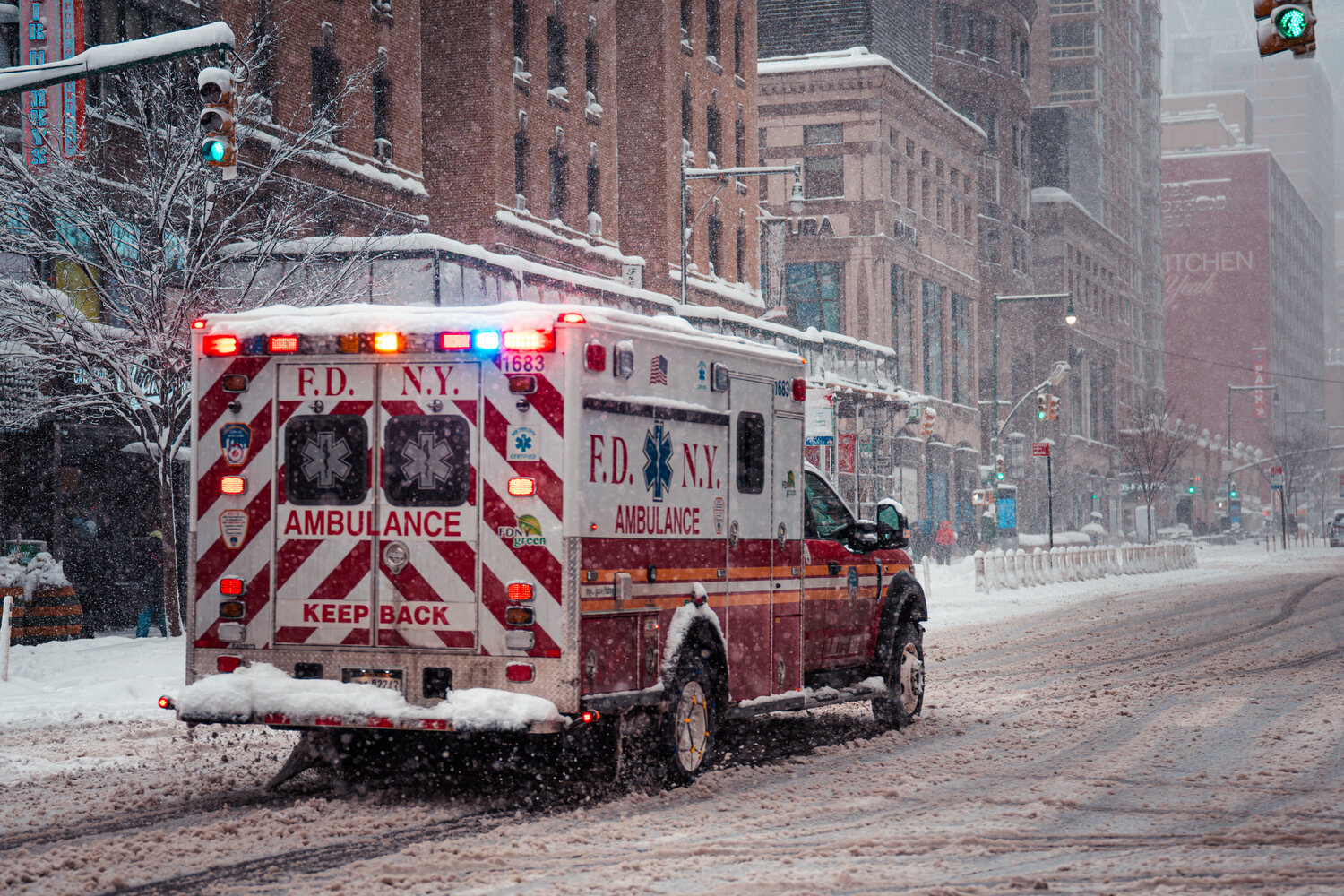
Job seekers don't show the same enthusiasm about becoming one of the FDNY emergency medical services' (EMS) roughly 3,000 emergency medical technicians (EMTs). Last summer then-FDNY Commissioner Robert Tucker said in an interview, "People just don't want to be EMTs anymore."
But year after year city officials, who set EMS salaries, ignore the primary cause, that is, after 5½ years on the job, EMTs who are required to keep up New York State Health Department certification to treat and transport the ill and the injured, have a base pay that is $35,782 less than sanitation workers. EMTs have been working under a contract that expired in 2022, and nothing's been said publicly about offering new EMTs even the same current starting salary of sanitation workers: $47,752.
At $39,386 a year (that's $18.93 an hour before income tax, Social Security and other deductions), an official city website describes EMT starting pay as "very low income" for an individual, and it only climbs to "low income" after 5½ years. So the FDNY hasn't been able to keep its EMT positions filled for a long time.
Year in and year out, EMS union officials and advocacy groups have publicized NYC's inability to hire and keep experienced EMTs. At a Council hearing last March, Tucker testified that just 3,500 people had applied to be FDNY EMTs during the prior application period. Of that number, he estimated perhaps 10 percent would become EMTs.
At the same hearing, Tucker noted that 1,000 EMTs, paramedics and EMS officers were expected leave the Emergency Medical Services for the department's firefighting wing. Left unsaid were reasons for the exodus: as firefighters, they will double their salaries after 5½ years, and as EMS employees they are hired as firefighters before successful test takers from the general public.
Just as the commissioner said, "You don't have to be an economics major to figure out, that 1,000 out and 350 in, leaves a gap."
Income and Outflow
City officials say they want to be fair to both taxpayers and to EMS workers in labor contracts. What's fair?
Tax dollars pay for the labors of both sanitation workers and EMTs. However, unlike for trash collection, an FDNY EMS ambulance transport comes with an additional charge to the individual, up to $1,692 plus oxygen and mileage.
In public discussions, city officials neglect to mention how these fees add up. In Fiscal Year 2025, NYC allocated for $374 million for EMS staffing. With 1.6 million calls for emergency medical help, it collected at least $506,882,000 through the work of its EMTs and paramedics.
According to the NYC Comptroller's website, third party reimbursements for EMS services on behalf of the Health & Hospitals Corporation added up to $2.1 billion dollars for NYC in the fiscal years 2020 through 2025.
As significant as EMS' income is for NYC, so are the wasted tax dollars. Insufficient salaries in the Emergency Medical Services costs millions because so much of its staff leaves.
Between 2022 and 2025, the FDNY hired more than a thousand EMTs. While they were in training, taxpayers paid for their salaries, uniforms, materials, equipment, instructors and so on, while at the same time many hundreds of trained EMTs were leaving the FDNY EMS.
Yearly, millions more tax dollars go to budgeted and unbudgeted overtime trying to keep FDNY ambulances running despite staff shortages. FDNY EMS overtime costs were 79 percent over budget In 2024.
In FY2025 taxpayers spent more than $60 million dollars on FDNY EMS overtime, millions of dollars more than initially planned. For this fiscal year, city officials did not add any additional EMS positions. They budgeted for 4,645 positions, similar to FY2025.
For the upcoming fiscal year, the Mayor's FY2027 Preliminary Budget calls for 41 fewer EMS staff. How will that affect both how long it takes for an ambulance to reach a patient and overtime expenses? A NYC Council hearing is scheduled for March 13 at City Hall about the Mayor's preliminary budget for the Fire Department, including its Emergency Medical Services.
If only the city followed its own law
Beginning with Rudy Giuliani, all NYC mayors since have fought against or ignored the 2001 city law requiring that in contract negotiations, the Office of Labor Relations (OLR) treat FDNY EMS personnel, who provide pre-hospital emergency medicine and transport, in the same way as it treats members of NYC's other "uniformed services", sanitation, fire, police and corrections.
Because this has never happened, a further Council Resolution in 2020 called for the city to pay FDNY EMS members comparably to police officers and firefighters. But neither that resolution nor the earlier law has ever been followed.
EMS pay hasn't even risen to that of sanitation workers. EMS contracts have never followed the larger "uniform services" pattern when it comes to yearly salary increases, thus the salary gaps have widened with every subsequent contract; and the contracts haven't been equitable in benefits such as sick leave.
It's not necessary to work for OLR or for the FDNY EMS to envision the minimal steps to take towards EMS pay parity. If, in the first year of a new EMS contract, FDNY EMT trainees were paid the same entry level base salary as Sanitation Workers are in 2026, they would earn $47,752 or 31 percent more than their current $36,330.
If they had the same size salary steps, that is, yearly pay increments, as do newly hired sanitation workers, they would double their base pay in five and a half years. Then along with their moral commitment, more EMS members would have the financial resources to remain working in emergency medicine.
And if career FDNY EMTs, with 5½ years on the job, were allotted parity payments just as the NYC Health and Hospitals Corporation nurses were in 2023, then together with NYC's larger "uniform services" pattern of pay raises, EMS wages would begin to approach that of sanitation workers.
These are just one New Yorker's observations.
But my belief is that OLR should follow the 2020 NYC Council Resolution to pay FDNY Emergency Medical Services personnel more, that is, comparable to NYC's other uniformed first responders, firefighters and police officers.
As the New York Times Editorial Board wrote in 2019, "New York’s emergency medical workers should be paid salaries and benefits far closer, if not equal to, the city’s firefighters. That’s what’s owed the tiny force of people providing New Yorkers with critical medical care in their hour of need."


1 comment on this item Please log in to comment by clicking here
Matthewsumner8
FDNY chooses to give their firefighter the lions share yet EMTs suffer. No wonder it’s a high turnover.
Wednesday, March 25 Report this