


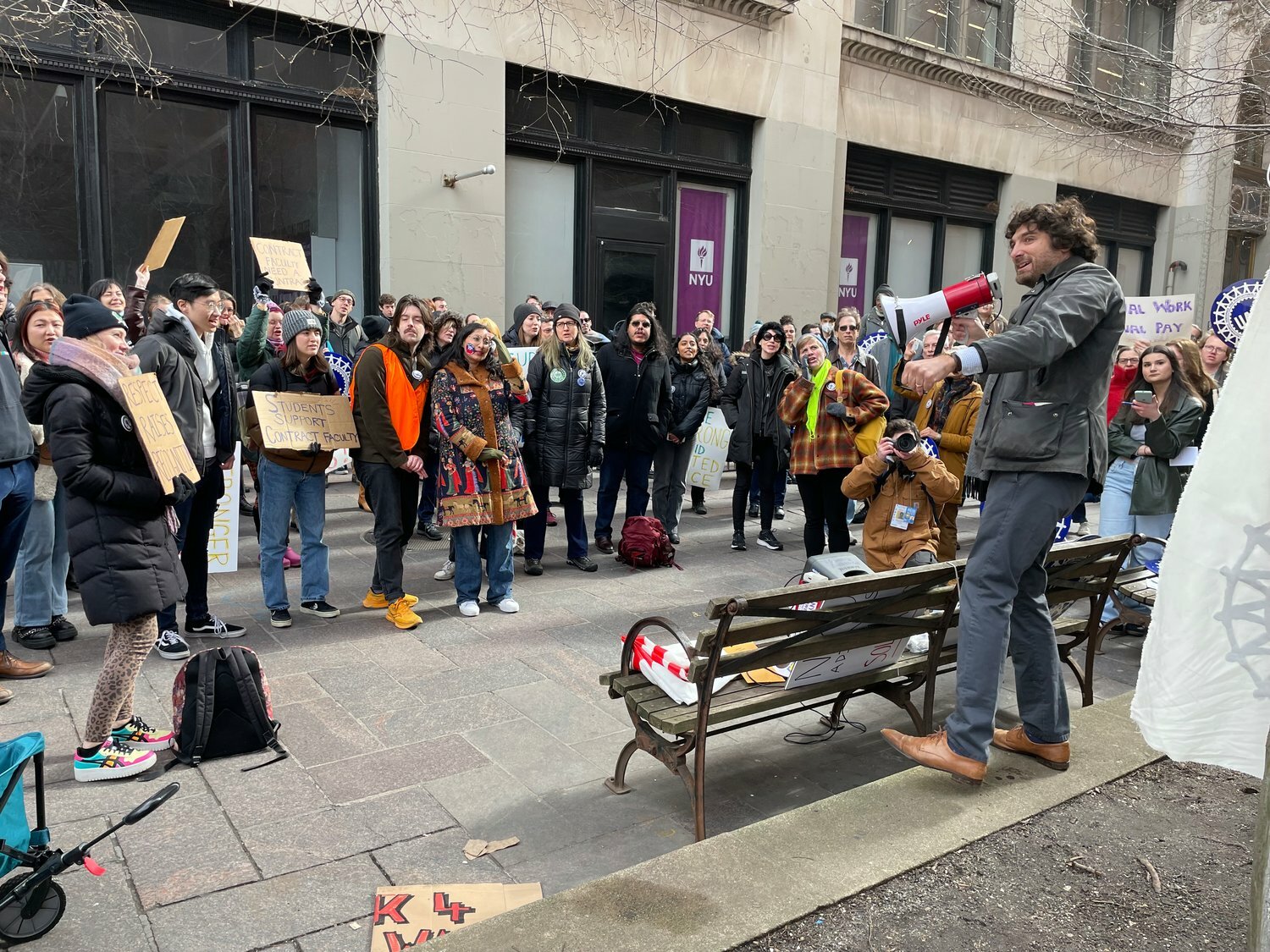
The surge of union organizing that started during the Covid pandemic have persisted — and those efforts have been mostly successful, according to a recent report by CUNY’s School of Labor and Urban Studies.
So far this year, nearly three-quarters of unions that submitted petitions to unionize to the National Labor Relations Board have won their elections. That 73-percent success rate represents a significant increase from 10 and 20 years ago: 62 percent of union drives succeeded in 2014 while just 52 percent prevailed in 2004. The number of election petitions, meanwhile, is the highest it’s been since 2015.
The report, co-authored by Ruth Milkman, a sociology professor at the School of Labor and Urban Studies, and Joseph van der Naald, a sociology professor at the Graduate Center, cited the tight labor market as an “important driver of the growth in union organizing” for the simple reason that the shortage of workers makes them less fearful of getting terminated for their unionizing efforts.
The growth in organizing has mainly been driven by young, college-educated employees working as journalists, medical residents, graduate workers and adjuncts who are more difficult to replace.
Uptick is here to stay?
Milkman believes there are several factors contributing to the growth of successful unionizing bids, among them that unions are being more selective about which workplaces they organize and a labor-friendly National Labor Relations Board.
“What I thought was the most striking was that a lot of people thought the uptick of organizing in 2022 was because of Covid, but I don’t think that’s going to change,” Milkman said during a phone interview this week. “This has been sustained since Covid, and that wasn’t a given.”
“One thing that’s not going to change is the support young people have for unions,” she added.
A 2023 survey by the AFL-CIO found that a record 88 percent of people under 30 reported being supportive of unions, compared with 71 percent of the overall population who were supportive.
Although organizing efforts at Starbucks have drawn much media attention, between January 2023 and June 2024, 3,472 employees were added to Starbucks Workers Union, a figure far behind other, larger unions.
Nationally, the Service Employees International Union, the United Auto Workers and the Teamsters added the largest number of new members between January 2023 and June 2024, according to the CUNY report. SEIU brought on nearly 31,000 members, while the UAW and Teamsters added nearly 24,000 and 11,632, respectively.
In New York City, the International Union of Journeymen and Allied Trades added the greatest number of new members, at 3,616, while the UAW added 1,571 members to their ranks and SEIU brought in 847. Last year, UAW Local 7902 organized undergraduate student workers at The New School, while resident physicians at Montefiore Medical Center chose to join the SEIU's Committee of Interns and Residents.
Just 8 percent of private-sector organizing efforts were voluntarily sanctioned, according to the report.
Notably, all of the IUJAT’s new members were voluntarily recognized by their employer. Connor Shaw, the union’s political director, explained that the union has been working to organize home health-care workers, hiring staff translators and reaching out online to try to engage with workers in the field.
“Home health-care workers are difficult to organize because they’re not showing up at one worksite,” he said. “To get voluntary recognition, you need 51 percent of the vote. But because people come and go, we want to make sure we have the support of 65 to 70 percent of the members.”
Shaw called organizing “the lifeblood” of any union. “I remember hearing that unions are like a bucket of sand — you’re always losing members,” and that’s why it’s important to always keep adding to their ranks, he said.
“I’m excited about the future of labor,” he said.
But the report made clear that the surge of organizing hasn’t been enough to offset decades of decline in the unionization rate, especially in the private sector. Nationally, just 10 percent of workers were unionized between January 2023 and this June, while in New York City, 19.8 percent of workers belonged to unions. New York State remained the state with the second-highest union density, at 20.6 percent, behind Hawaii’s 24.1 percent.
The rate of private-sector workers who were unionized in New York City was 13.5 percent, more than twice the nation’s 6-percent rate. The rate of unionized public-sector workers in the city – 63.1 percent – and in New York State – 63.7 percent – was nearly double that of the national rate of 32.2 percent.


Comments
No comments on this item Please log in to comment by clicking here